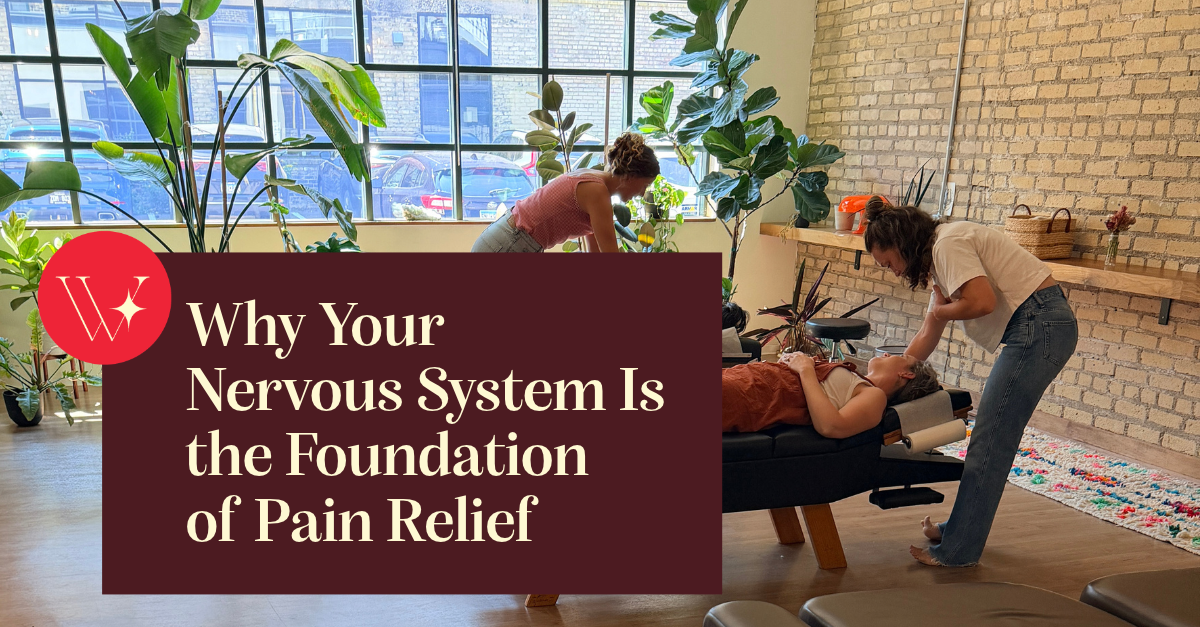
Most people think of pain like a smoke alarm: something's broken, so it goes off. It's a bit more complicated than that, and understanding why can change how you heal.
Pain isn't just about damaged tissue
Pain is real, and it's created by your nervous system, which is your brain, spinal cord, and nerves. Your muscles and joints are part of the story, but so is your stress, your history, and how safe your body feels.
Sometimes the volume gets turned up too high
Pain researchers describe a process where the nervous system becomes extra sensitive, like a volume knob stuck on loud. When that happens, even a light touch can start to feel painful, and normal sensations can set off pain. Pain depends not just on what's happening in the tissue, but on how "turned up" your nervous system is (Woolf, 2011).
If you've ever wondered why pain lingers after an injury has healed, jumps around, or flares up for no clear reason, this is often part of the answer.
Stress and pain feed each other
We see this in the clinic all the time. Researchers have found that chronic pain and chronic stress are closely linked, and some describe them as two sides of the same coin (Abdallah & Geha, 2017). A body that stays on high alert tends to be tighter, more sensitive, and slower to recover. Poor sleep, under-eating, overtraining, and a stressful season of life all add to that load.
When the nervous system calms down, the body moves and heals better.
What this looks like at your visit
When we talk about "regulation," we mean helping your nervous system shift out of constant protection mode. In your care, that can include:
Hands-on work. Adjustments, massage, physical therapy, and soft tissue work help your body settle.
Movement. Gradual strength and mobility work teaches your body that moving is safe again.
Education. Understanding why you hurt is part of healing.
The basics. Sleep, food, rest, and recovery are part of the treatment, not extras.
What this means for you
If your pain keeps coming back, moves around, or seems bigger than the original injury, you're not being dramatic. Often, your body just needs help settling down.
At your visit, we'll look at how your joints and muscles are working, and also at your stress, sleep, training, and history, so your care fits you.
New patients are always welcome.
Stop by our clinic in North Loop, Minneapolis.
_____________
References
Abdallah, C. G., & Geha, P. (2017). Chronic pain and chronic stress: Two sides of the same coin? Chronic Stress, 1, Article 2470547017704763. https://doi.org/10.1177/2470547017704763
Woolf, C. J. (2011). Central sensitization: Implications for the diagnosis and treatment of pain. Pain, 152(3 Suppl), S2–S15. https://doi.org/10.1016/j.pain.2010.09.030