Healing After Surgery
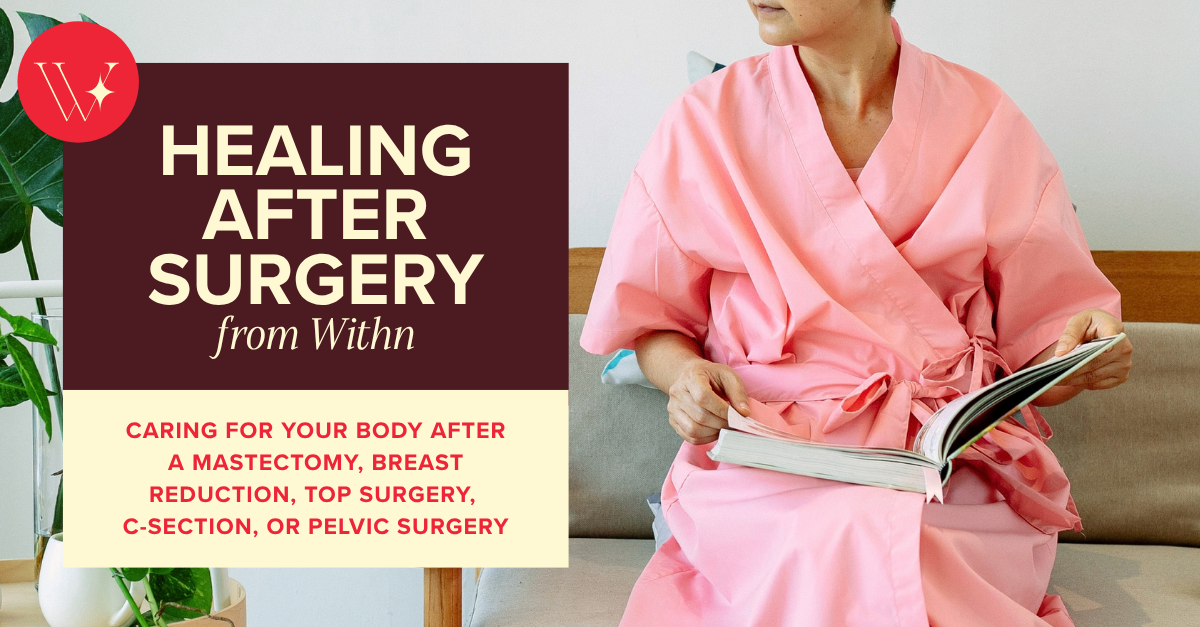
Caring for Your Body After A Mastectomy, Breast Reduction, Top Surgery or Pelvic Surgery
October is both Breast Cancer Awareness Month and LGBTQ+ History Month, two communities that know a lot about what it means to heal after surgery.
Whether you're recovering from a mastectomy, lumpectomy, breast reduction, top surgery, a C-section, a hysterectomy, a prolapse repair, or gender-affirming bottom surgery, your body has been through something big. And very often, so have you.
At Withn, we believe healing is relational. Recovery isn't only about an incision closing. It's about how your tissue, your posture, your nervous system, and your sense of safety in your own body come back online. Here's what Dr. Taylor and Dr. Emily want you to know.
After chest surgery, scar tissue is the big one
After a breast reduction, mastectomy, top-surgery or lumpectomies, the first thing we pay attention to is scar tissue. Scars sitting under or across the chest can create real restriction, and over time, that restriction limits how your shoulders and upper back are able to move.
When that tissue isn't released or kept mobile, it tends to pull the shoulders forward into a rounded, rolled position. That rounding is often where the pain shows up: the upper back, the mid-back, and the neck. Many people don't connect that pain to their surgery at all.
Gentle scar mobilization, once your surgeon has cleared you, helps keep that tissue moving so it doesn't quietly rewrite the way you stand and move.
Opening up the upper back
After almost any surgery, the thoracic spine (your upper and mid-back) tends to stiffen. Opening it back up helps restore a natural range of motion so your shoulders, ribs, and neck can move the way they're meant to.
There's a nervous-system piece here, too. Surgery is a big stress on the body. Adjustments can help your nervous system relax and come back to balance, and a body that feels safe is a body that heals.
Your center of gravity may change
Depending on chest size before surgery, some people suddenly carry several fewer pounds on the front of their body. That's a meaningful change in how gravity pulls on you, and it changes how your body moves, often in ways you don't notice until something starts to ache.
Chiropractic care and good bodywork after surgery help you adjust to that new normal and find your new flow.
Pelvic and lower-body surgery: compassion first
Any surgery involving the lower body or pelvic floor, C-sections, hysterectomies, prolapse repairs, pelvic reconstruction, bottom surgery deserves care from multiple directions.
These surgeries can be physically demanding and emotionally significant. Any pelvic surgery comes with a plethora of emotions which are often complicated. For many patients, there is a combination of relief and grief. For others, surgery is a long-awaited and joyful step. Whatever your reason, you deserve care that holds space for all of it.
After surgery, your nervous system often stays on guard, holding a lot of protection around what happened. That's why a compassionate adjustment matters so much. As our doctors put it, there are a lot of chiropractors who can adjust you. What matters is finding one who understands what your body went through, physically, mentally, and emotionally.
There's a practical side, too. Lower-body surgeries often mean long stretches of limited movement, which creates stiffness and muscle pain. Gentle mobilization helps, and it's always done to meet you exactly where you are.
Care is a team sport
Healing rarely happens in one room. Several of our patients have worked with a trusted acupuncturist who specializes in chest surgery recovery, which can be very helpful for releasing deeper scar tissue adhesions and restoring a sense of flow in the body. Physical therapy and massage can also be part of the plan, and we'll help you figure out what makes sense for you.
What to expect at Withn
We always follow your surgeon's guidance on timing.
We'll talk first, about your surgery, your recovery, and how you're feeling in your body.
Every step is consent-based. We explain before we touch, and you can pause anytime.
Your plan is built around you, because what one body needs can be the exact opposite of what another needs.
You may experience emotional release during treatment. Know you are in a safe space to feel those emotions and let them flow through you. This is a big part of the healing process!
Healing after surgery isn't about going back to who you were before. It's about getting to know your body as it is now, and feeling at home in it.
That's where healing starts: from withn.
Ready to start? New patients are always welcome.
Book your visit: https://withn.janeapp.com/